






 Cooled Radiofrequency Ablation (RFA)
 Tined Radiofrequency Ablation (RFA)
 Conventional Radiofrequency Ablation (RFA)
 RFA Equipment & Accessories
 Needles, Kits, and Trays
 Elastomeric Pain Pumps and Kits
 Needles, Kits, and Trays (Incisional and PNB)
 Cryo Compression Control Unit Systems
 Cryo Compression Sleeves and Wraps
 Feeding Tube Placement Device
 Feeding Tube Retention Systems
 Declogging and Decompression
 Feeding Tubes and Accessories
 Introducer Kits and Accessories
 Feeding Tube Extension Sets and Adapters
 Enteral Medication Preparation & Delivery
 Feeding Accessories
 Feeding Pumps
 Feeding Syringes
 Feeding Tubes and Extension Sets
 Lumbar Puncture Trays and Needles
 Oral Care/Colostrum Kits and Components
 Urinary Catheters & Kits
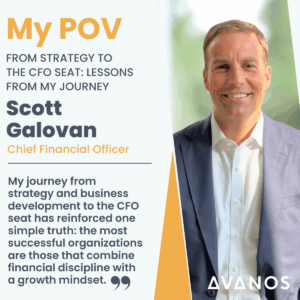
by Scott Galovan, Chief Financial Officer – Avanos Medical
Stepping into the Chief Financial Officer role for the first time is both exciting and humbling. I’ve spent much of my career in strategy and business development, disciplines that focus on the future, on opportunities, on creating long-term value and managing risk. Now, in the CFO seat, I have the privilege of bringing that same discipline to finance, helping ensure our company not only manages today’s performance but also positions itself for tomorrow’s success.
Connecting Strategy and Finance
My experience in strategy taught me to think broadly about how businesses grow and sustain success. Strategy isn’t just about setting goals, it’s about making choices, identifying where to invest, determining how to win and managing risk. In that work, I learned to ask questions like: Where is the market heading? What will customers need tomorrow that they don’t yet realize today? How do we position ourselves for advantage five years from now? How can we effectively leverage our existing resources and infrastructure?
As CFO, these same questions are critical. Finance provides the tools to measure performance, but strategy provides the context that gives those numbers meaning. When you connect the two, aligning financial discipline with strategic direction, you create the ability to not just report results but to influence them.
Business Development: A Growth Mindset
Business development gave me another important perspective: how to pursue opportunities for growth. Whether evaluating partnerships, exploring new markets, or assessing acquisitions, the work was about balancing risk with potential value creation. It requires financial rigor but also imagination and the ability to envision possibilities.
That same mindset translates directly to the CFO role. Every investment decision – whether in technology, people, new products or expansion – comes with trade-offs. My background in business development enables me to weigh those choices not only with an eye on immediate returns, but also in how they fit into our strategic direction. Growth isn’t just a number on a spreadsheet; it’s the result of deliberate choices that align with long-term strategy.
Lessons in Leadership
One of the most important lessons I’ve learned in this transition is that finance is a team sport. The CFO’s role isn’t just about balancing budgets or signing off on forecasts, it’s about building trust across the organization. It’s about creating transparency, enabling collaboration, and making sure every function has the insights they need to succeed.
In practice, this means spending as much time listening as talking. It means working side-by-side with colleagues in operations, sales, marketing, and beyond, to ensure that financial strategies support their goals. It also means developing a finance team that is empowered, curious, and engaged, because they are the ones who turn data into insights and insights into action.
Priorities in the New Role
As I settle into this role, my focus is on a few key priorities:
- Partnering with leadership and our Board to ensure our financial strategies and resources support our broader vision for growth.
- Strengthening the finance team by equipping them with the tools and resources they need to do their best work.
- Balancing discipline with opportunity, preserving the company’s financial health while investing boldly in the areas that will define our future.
These priorities are not static. They will evolve as our business and our environment evolve. But they are grounded in the belief that finance is not just about managing risk, it’s about enabling potential.
Looking Ahead
I am honored to take on this role at such a pivotal time for our company. My journey from strategy and business development to the CFO seat has reinforced one simple truth: the most successful organizations are those that combine financial discipline with a growth mindset. Numbers matter, but so do vision, creativity, and collaboration.
I look forward to continuing to learn, to grow, and to partner with colleagues across the business as we shape the next chapter of our story. And I’d love to hear from others: what lessons have you carried with you when stepping into a new role?
Stepping into the Chief Financial Officer role for the first time is both exciting and humbling. I’ve spent much of my career in strategy and business development, disciplines that focus on the future, on opportunities, on creating long-term value and managing risk. Now, in the CFO seat, I have the privilege of bringing that same discipline to finance, helping ensure our company not only manages today’s performance but also positions itself for tomorrow’s success.
Connecting Strategy and Finance
My experience in strategy taught me to think broadly about how businesses grow and sustain success. Strategy isn’t just about setting goals, it’s about making choices, identifying where to invest, determining how to win and managing risk. In that work, I learned to ask questions like: Where is the market heading? What will customers need tomorrow that they don’t yet realize today? How do we position ourselves for advantage five years from now? How can we effectively leverage our existing resources and infrastructure?
As CFO, these same questions are critical. Finance provides the tools to measure performance, but strategy provides the context that gives those numbers meaning. When you connect the two, aligning financial discipline with strategic direction, you create the ability to not just report results but to influence them.
Business Development: A Growth Mindset
Business development gave me another important perspective: how to pursue opportunities for growth. Whether evaluating partnerships, exploring new markets, or assessing acquisitions, the work was about balancing risk with potential value creation. It requires financial rigor but also imagination and the ability to envision possibilities.
That same mindset translates directly to the CFO role. Every investment decision – whether in technology, people, new products or expansion – comes with trade-offs. My background in business development enables me to weigh those choices not only with an eye on immediate returns, but also in how they fit into our strategic direction. Growth isn’t just a number on a spreadsheet; it’s the result of deliberate choices that align with long-term strategy.
Lessons in Leadership
One of the most important lessons I’ve learned in this transition is that finance is a team sport. The CFO’s role isn’t just about balancing budgets or signing off on forecasts, it’s about building trust across the organization. It’s about creating transparency, enabling collaboration, and making sure every function has the insights they need to succeed.
In practice, this means spending as much time listening as talking. It means working side-by-side with colleagues in operations, sales, marketing, and beyond, to ensure that financial strategies support their goals. It also means developing a finance team that is empowered, curious, and engaged, because they are the ones who turn data into insights and insights into action.
Priorities in the New Role
As I settle into this role, my focus is on a few key priorities:
- Partnering with leadership and our Board to ensure our financial strategies and resources support our broader vision for growth.
- Strengthening the finance team by equipping them with the tools and resources they need to do their best work.
- Balancing discipline with opportunity, preserving the company’s financial health while investing boldly in the areas that will define our future.
These priorities are not static. They will evolve as our business and our environment evolve. But they are grounded in the belief that finance is not just about managing risk, it’s about enabling potential.
Looking Ahead
I am honored to take on this role at such a pivotal time for our company. My journey from strategy and business development to the CFO seat has reinforced one simple truth: the most successful organizations are those that combine financial discipline with a growth mindset. Numbers matter, but so do vision, creativity, and collaboration.
I look forward to continuing to learn, to grow, and to partner with colleagues across the business as we shape the next chapter of our story. And I’d love to hear from others: what lessons have you carried with you when stepping into a new role?
